Every 12 June, the International Labour Organization joins forces with ILO constituents and partners around the world to commemorate the World Day Against Child Labour. This International Day was launched by the International Labour Organization (ILO) in 2002.

This year’s theme reflects both the progress achieved and the urgency to intensify action to meet global targets. Despite progress, child labour still affects 138 million children globally.
According to the data, agriculture remains the largest sector for child labour, accounting for 61 per cent of all cases, followed by services (27 per cent), like domestic work and selling goods in markets, and industry (13 per cent), including mining and manufacturing.
Asia and the Pacific achieved the most significant reduction in prevalence since 2020, with the child labour rate dropping from 5.6 per cent to 3.1 per cent (from 49 million to 28 million children). Latin America and the Caribbean achieved an 8 per cent relative reduction in prevalence and an 11 per cent decline in total numbers, the report notes.
Sub-Saharan Africa continues to carry the heaviest burden, accounting for nearly two-thirds of all children in child labour – around 87 million. While prevalence fell from 23.9 to 21.5 per cent, the total number has remained stagnant against the backdrop of population growth.
To accelerate progress, UNICEF and ILO are calling for governments to:
• Invest in social protection systems, especially for vulnerable households, including universal child benefits, so families do not resort to child labour.
• Strengthen child protection systems to identify, prevent, and respond to children at risk, especially those facing the worst forms of child labour.
• Provide universal access to quality education, especially in rural and crisis-affected areas, so every child can learn.
• Ensure decent work for adults and youth, including workers’ rights to organize and defend their interests.
• Enforce laws and business accountability to end exploitation and protect children across supply chains.
Child labor laws in India are primarily governed by the Child Labour (Prohibition & Regulation) Act, 1986, which has been amended in 2016 and is now known as the Child and Adolescent Labour (Prohibition and Regulation) Act, 1986.
THE CHILD LABOUR (PROHIBITION AND REGULATION) AMENDMENT ACT, 2016
This law prohibits the employment of children below the age of 14 in any occupation or process, with certain exceptions. The Act also regulates the working conditions of adolescents (14-18 years) in certain hazardous occupations.
Article 24 of the Indian Constitution:
Prohibits the employment of children below the age of 14 years in factories, mines, or any other hazardous employment.
Any person who employs a child below 14 or a child between 14 and 18 in a hazardous occupation or process can be punished with jail time of between six months and two years and/or fine between Rs. 20,000 and Rs. 50,000.
A person can be punished for all other violations (for example, with respect to maintenance of register, work hours, health and safety conditions) with jail time of up to one month and/ or a fine of up to Rs. 10,000. First time offences can be settled if the person pays a certain sum of money.
Is it legal to make children work in the family business?
Yes, it is legal to make children (below 14) work in the family business. The business could belong to or be run by immediate family (mother, father, brother or sister) or extended family (father’s sister and brother, or mother’s sister and brother).
Is it legal to let children act in movies or play sports as a profession?
Yes, it is legal. Children can act in movies and TV serials or be involved in sport activities and be paid for it. They could also do this as a hobby. The government has not yet come out with the full list of allowed entertainment and sporting activities under this exception. Also, the rules regarding the conditions of employment of such children have not yet come out. Again, it is important that the child’s education is not affected.
What kind of jobs are children between 14 and 18 allowed to work in?
The law only tells us what kind of jobs they are not allowed to work in. Adolescents or children (between 14 and 18) are generally allowed to work except in:
1. Hazardous occupations – Mines and inflammable substances or explosives (such as firework factories).
2. Hazardous processes – The list of industries which use hazardous processes is provided under the law - the Factories Act, 1948. They include coal, power generation, paper, fertilizer, iron and steel industries, asbestos, etc.
3. The government can make additions or deletions to this list.
Age Verification: Employers are required to verify the age of potential employees to ensure compliance with the law, often through Aadhaar Card. This is the main reason a Resume / CV had the date of birth as one of the essential eliminates.
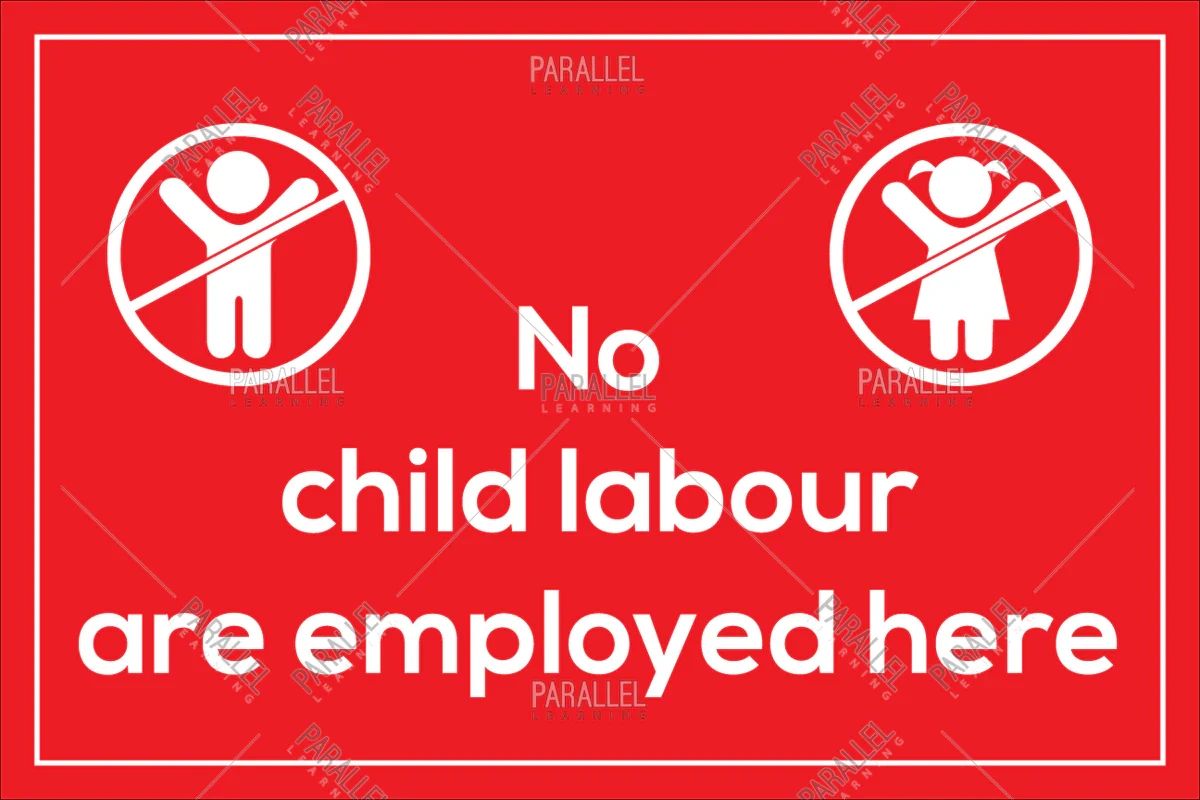
NOTICE - NO CHILD LABOR EMPLOYEED
It is mandatory statutory compliance as per THE CHILD LABOUR (PROHIBITION & REGULATION) ACT, 1986, to display that no child labor is employed.
Along with that, you have to display the penalties for conviction (Section 14) as well.

Comments
Post a Comment